
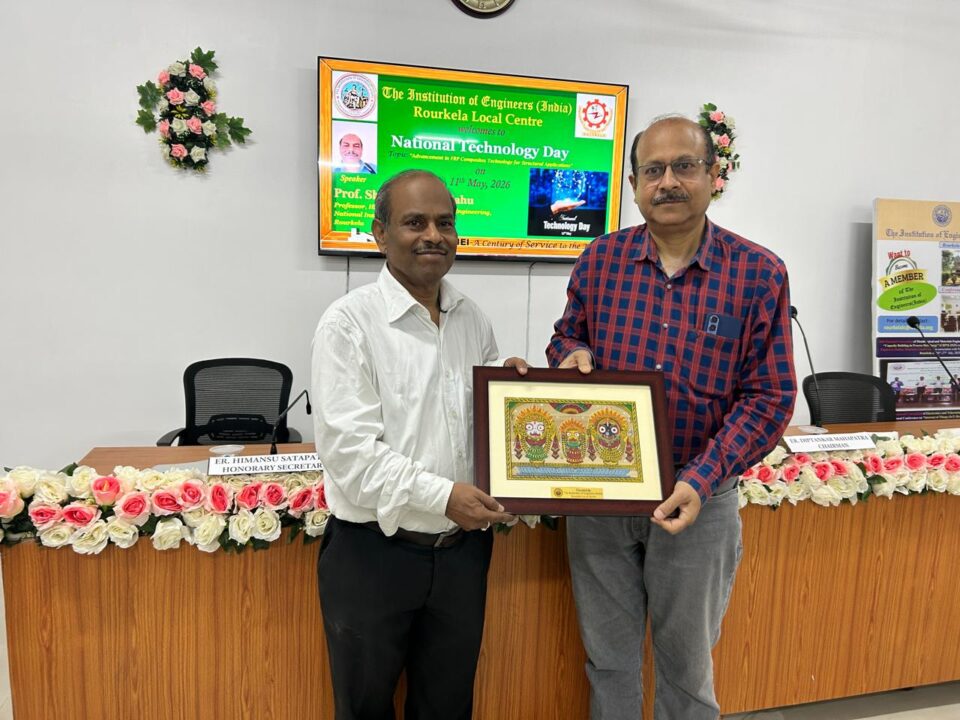
National Technology Day observed by the Institution of Engineers (India) Rourkela
Rourkela : National Technology Day was observed by the Institution of Engineers (India), Rourkela Local Centre .The event was conducted in a hybrid mode, both online and offline, on the topic “Advancement in FRP Composites Technology for Structural Applications”. The speaker for the occasion was Prof. Shishir Kumar Sahu, Professor, HAG in Department of Civil Engineering, National Institute of Technology Rourkela. The programme was coordinated by the Honorary Secretary, Er. Himansu Satapathy. The meeting was chaired by Chairman, Er. Diptankar Mahapatra, who delivered the welcome address. The Honorary Secretary briefly introduced the speaker and invited Prof. Sahu to deliver his lecture. In his presentation, Prof. Sahu highlighted that the present study investigates the dynamic instability of rectangular carbon nanotube–reinforced composite (CNTRC) plates subjected to periodic in-plane compressive loading. Numerical analysis is carried out using the first-order shear deformation theory (FSDT) in conjunction with the finite element method (FEM). The composite plates are reinforced with multi-walled carbon nanotubes (MWCNTs) incorporated at different weight percentages relative to the matrix material.
Experimentally determined material properties of the fabricated CNTRC plates are employed in the numerical simulations. The dynamic instability regions (DIRs) are evaluated using Bolotin’s first approximation. A comprehensive parametric study is performed to examine the effects of CNT weight percentage, aspect ratio, plate thickness, and boundary conditions on the dynamic instability behavior of the plates. In the present work, a finite element formulation is developed to investigate the free vibration, buckling, and dynamic stability characteristics of industry-oriented woven fiber laminated composite plates and shell panels. The results obtained using the present finite element model show good agreement with those available in the existing literature, thereby validating the accuracy and reliability of the formulation.
From the present investigations, it can be concluded that the vibration behavior of laminated composite plates is significantly influenced by several factors, including geometry, material properties, ply lay-up sequence, temperature, moisture concentration, delamination, curvature, fiber orientation, and the type of constituent materials. It is further observed that the first and fourth mode shapes are not significantly affected by an increase in temperature. However, noticeable changes in convexity and concavity are observed in the second and third mode shapes with increasing temperature, possibly due to modal transition or mode shifting effects.
The presentation was followed by an engaging interactive session involving industrialists and academicians. Subsequently, Er. Mahapatra presented a certificate of merit and a memento to Prof. Sahu in recognition of his insightful contribution. The programme concluded with a vote of thanks proposed by the Honorary Secretary, Er. Himansu Satapathy. A total of 24 members and guests participated in the event, both online and offline.
Reported by Kunja Bihari Rout